A primary challenge for food brands today is sourcing climate-resilient grains that offer a reliable supply chain, meet clean-label standards, and deliver strong nutritional benefits amid increasing crop volatility.
In the past two decades, quinoa has become the global standard for ancient grains. Originally a regional staple in the Andes, it is now widely used in frozen entrées, grain bowls, snack bars, plant-based products, and school lunch programs. Quinoa’s appeal lies in its complete protein profile, gluten-free status, and strong consumer recognition. However, as the market matured, structural challenges emerged.
According to the International Trade Centre, global quinoa exports increased by more than 235% between 2012 and 2015—driving sharp price swings for buyers. Estimates place quinoa’s carbon footprint at approximately 1.5–2 kg CO₂e per kg, and in some regions, scaling practices contributed to soil degradation and biodiversity loss. Climate research has also highlighted the growing vulnerability of quinoa-producing regions to overlapping environmental and market disruptions (see analysis published in Global Environmental Change).
Currently, a new question is emerging:
With the European Union’s deforestation regulation (EUDR) taking effect in 2026 and climate instability threatening staple crops, what will the next generation of climate-smart grains look like?
Fonio, a West African grain cultivated for over 5,000 years, is increasingly viewed as a strategic complement to quinoa. It offers unique nutritional, environmental, and economic benefits, broadening ingredient options.
Nutritional Comparison: Fonio vs. Quinoa

Quinoa and fonio serve distinct functional roles in product formulation.
Macronutrients (Cooked, Approximate Averages)
| Calories | ~170 per cup | ~220 per cup |
| Protein | ~2–3g | ~8g |
| Fat | <1g | ~3.5g |
| Carbohydrates | ~39g | ~39g |
| Fiber | ~1–2g | ~5g |
Quinoa’s high protein and fiber content make it prominent in protein-focused and performance nutrition categories, while fonio’s distinct strengths are often overlooked.
As detailed in our previous review of fonio’s nutritional profile, the grain provides:
- Meaningful levels of iron and zinc
- Naturally low glycemic response
- Notable methionine and cysteine content—amino acids often limited in plant-based diets
- High digestibility
For product developers, fonio functions less as a protein substitute and more as a light, micronutrient-rich carbohydrate base. Its delicate texture and neutral flavor enhance application flexibility, particularly in gluten-free innovation and culinary environments, as demonstrated in collaborations with chefs and foodservice partners.
Environmental Sustainability: Climate Resilience in Practice

Fonio stands out from quinoa and other ancient grains due to its agronomic performance.
Quinoa’s global expansion required moving beyond traditional Andean systems. In some regions, this led to increased irrigation, monocropping, and greater market volatility. While quinoa remains valuable, its rapid commercialization shows that heritage crops can become vulnerable when demand exceeds sustainable management.
Fonio’s growth trajectory is different.
As one of the fastest-maturing cereals in the world—harvestable in just 6–8 weeks—fonio thrives in the Sahel region of West Africa under conditions where many crops fail. Agronomic research from the Fonio Alliance highlights its:
- Rain-fed cultivation
- Minimal fertilizer requirements
- Adaptability to sandy, nutrient-poor soils
- Strong drought tolerance
These characteristics provide significant sustainability advantages. Reduced irrigation and input needs lower production risk and support more stable long-term sourcing.
Regulatory changes further strengthen this advantage. As EUDR compliance becomes mandatory, traceability and safeguards against deforestation are essential. Terra’s farmer partnership model and early regulatory preparation were established ahead of enforcement timelines.
This foresight is important for procurement teams managing compliance requirements.
Economic Sustainability: Growth Structured Around Communities

Successful scaling of ancient grains depends on both community engagement and acreage.
A key difference between quinoa’s rapid expansion and fonio’s growth is how development is structured at the community level.
Annual Guinea impact reports show measurable progress in farmer income, acreage expansion, and processing improvements, as detailed in the 2024 report and our recent Year Two update.
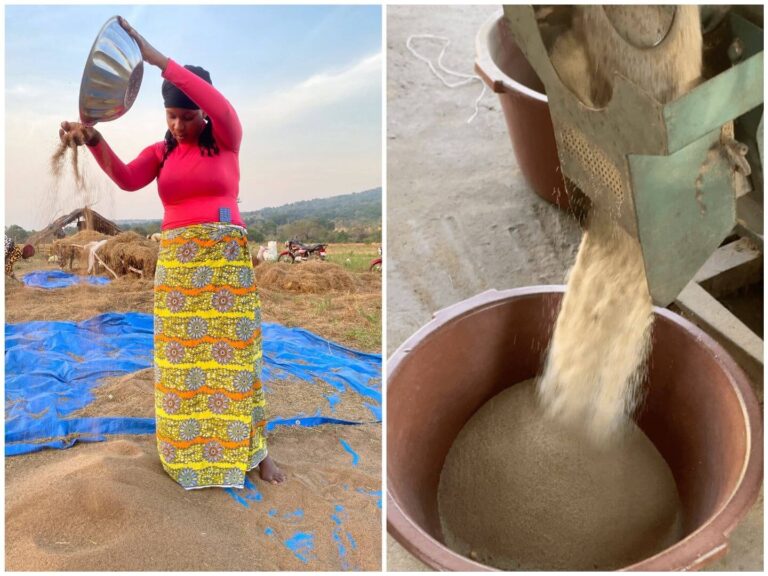
The role of women in fonio production is equally significant. In many communities, women have historically led post-harvest handling. As demand expands, their economic participation strengthens, a shift explored in the profile on our own Maimouna Diallo.
For brands evaluated on ESG performance, supply chain transparency, and social impact, this dimension is strategic rather than symbolic.
Processing & Supply Chain Realities

Operational feasibility is central to any ingredient decision.
Quinoa benefits from established global processing infrastructure, including standardized desaponification and export systems. Fonio, once limited by labor-intensive dehusking, has improved through mechanization and investments in quality control. Processing consistency and throughput continue to rise as demand grows across categories.
That demand is also diversifying. Breweries are incorporating fonio into gluten-free and flavor-forward beer formulations, strengthening the ingredient’s economic ecosystem beyond a single vertical. Growth across packaged foods, foodservice, and beverage markets reduces concentration risk and supports more stable expansion.
Market Placement: Complementary, Not Competitive
Positioning fonio as a direct replacement for quinoa oversimplifies its potential.
Quinoa remains well-positioned in:
- Protein-forward applications
- Established retail channels
- Large-scale commodity supply
Fonio differentiates through:
- Low-input cultivation systems
- Short growth cycles
- Culinary versatility
- Transparent sourcing partnerships
As environmental and market pressures rise in traditional quinoa-growing regions, fonio offers brands a practical diversification strategy rather than a direct substitute.
Importantly, fonio is not limited to industrial applications. Its neutral flavor and light texture work well in consumer products such as grain bowls, porridges, salads, and baked goods. For brands exploring new product development, our culinary team has highlighted several application-ready fonio recipes in 3 Healthy Fonio Recipes to Make Your Mouth Water.
These examples show how fonio integrates seamlessly into familiar formats, lowering the barrier to innovation.
Strategic Considerations for Food Brands

When evaluating fonio and quinoa, manufacturers should focus on four practical areas:
- Portfolio Diversification: Reduce exposure to crop-specific climate risks.
- Regulatory Alignment: Ensure traceability and compliance with evolving standards such as EUDR.
- Formulation Flexibility: Leverage fonio’s digestibility and texture across gluten-free and plant-based categories.
- Brand Credibility: Build long-term trust through transparent sourcing and measurable impact.
Looking Ahead
Quinoa has shown that heritage crops can scale globally. Fonio is entering international markets at a time shaped by climate volatility, regulatory scrutiny, and higher expectations for supply chain transparency.
The question is not whether quinoa remains valuable—it does. The real question is whether ingredient portfolios should evolve to reflect changing agricultural realities.
Fonio offers brands a measured, forward-looking addition that strengthens resilience without requiring complete replacement.